
Epizootic hemorrhagic disease, cattle - Morocco: OIE alert
International Society for Infectious Diseases
<http://www.isid.org>
Source: OIE Disease Alert [edited]
< http://www.oie.int/Messages/060918MAR.htm>
Epizootic hemorrhagic disease in Morocco: (Disease never reported
before in Morocco).
Translation of information received on 14 Sep 2006 from Dr Hamid
Benazzou, Director of Animal Production Department, Ministry of
Agriculture and Rural Development, Rabat:
Report date: 14 Sep 2006.
Reason for immediate notification: an emerging disease with
significant morbidity or mortality or zoonotic potential.
Identification of agent: Orbivirus.
Date of 1st confirmation of the event: 8 Sep 2006.
Date of start of the event: 28 Jul 2006.
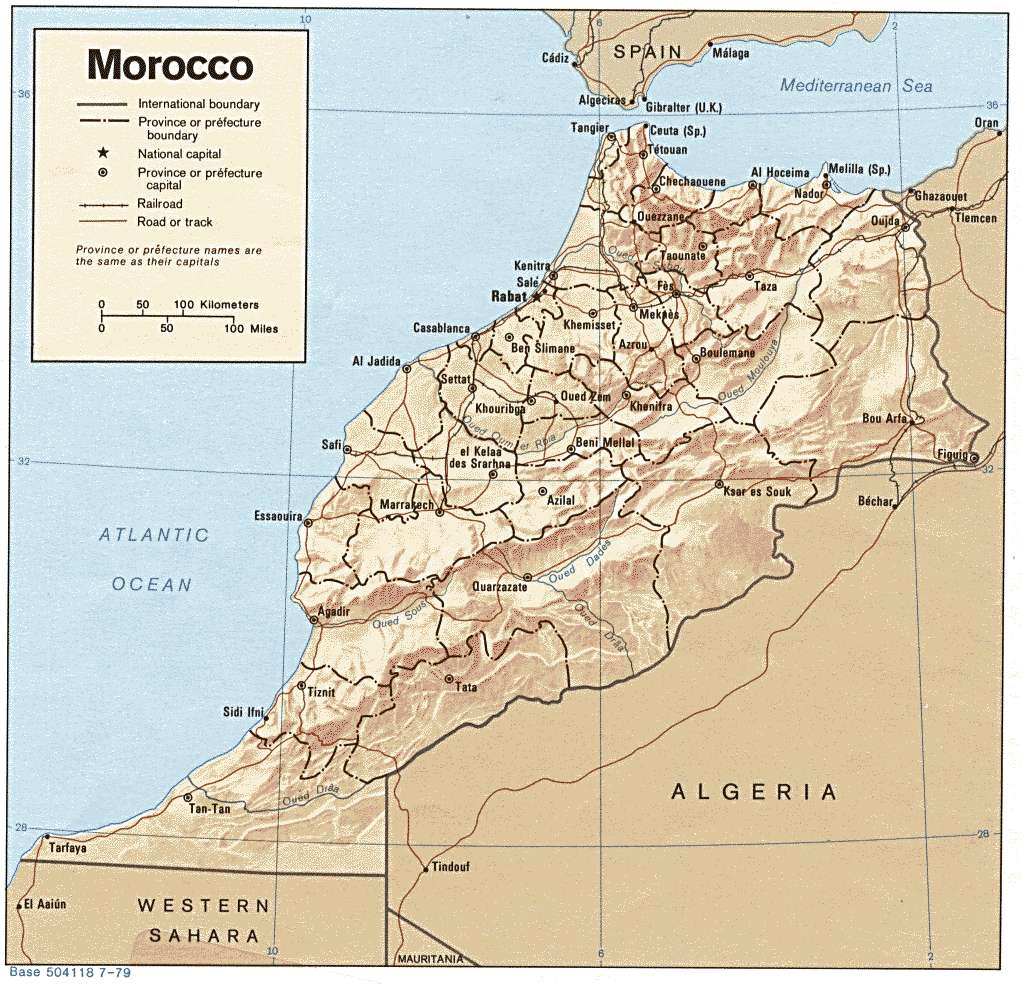
23 outbreaks of epizootic hemorrhagic disease have been reported in
cattle in the provinces of Jerada, Oujda Angad, Taza, Taourirt,
Figuig and Khenifra (30 cases out of 128 susceptible animals).
The diagnosis has been made by Biopharma, Rabat, using PCR and ELISA.
Source of outbreaks or origin of infection: unknown or inconclusive.
Control measures undertaken:
- control of arthropods;
- control of wildlife reservoirs;
- quarantine;
- disinsectisation of infected premises/establishments;
- awareness campaign for veterinarians and farmers;
- reinforced surveillance of clinical signs of the disease.
Affected animals have been treated with antibiotics,
anti-inflammatories and antiseptics.
Epizootic hemorrhagic disease (EHD) usually affects deer, does not
appear to infect sheep and rarely causes disease in cattle. However,
the morbidity rate in this instance seems quite high. Such
comparatively high attack rates are seen when a completely new virus
enters a population. EHD should not be considered a zoonoses, so the
reason for a Disease Alert is that it appears that this disease is in
the process of emerging.
Of course, there are 2 theoretical steps in the emergence of a new
disease: 1) the occurrence of a newly emerged infection in the
population and 2) ongoing transmission in the population. There are
many instances in which the 2nd step does not effectively occur. And
while we can quibble over whether the 23 herds reported here indicate
ongoing transmission, the occurrence is over wide areas of the
northern part of the country, ranging from the eastern desert to the
Mediterranean to the Atlantic near Casablanca. See map with some of
the affected areas at:
< http://www.lib.utexas.edu/maps/africa/morocco.gif>.
Such wide expanses with affected herds are not unexpected with a
newly introduced virus but do argue for the disease becoming well
established by ongoing transmission. A most interesting point is
what, if any, is the nature of the relationship with similar
outbreaks reported in Israel this week; see below.
Clinical descriptions are referenced in the previous postings:
Pictures of clinical cases are electronically available at:
<http://www.vetserv.moag.gov.il/VetServ/Files/News/khol_ha_lshon.htm>
(in Hebrew, but click on the pdf logo, and see at the bottom of the
document 4 pictures and a map).
<http://www.icba.org.il/hitpartsut-09-2006.htm> (15 pictures under
the Hebrew text).
Control of this outbreak depends on control of the _Culicoides_
vectors involved and is best done with the initiation of appropriate
vector control strategies and repellents.

 Posts
Posts


No comments:
Post a Comment